The Institute of Contemporary Art San Francisco is on the move again. But instead of settling into a permanent location, they’re adopting a nomadic model across the city.
San Francisco Chronicle
This S.F. museum is leaving its downtown home for new ‘nomadic model’
Tony Bravo, Oct 28, 2025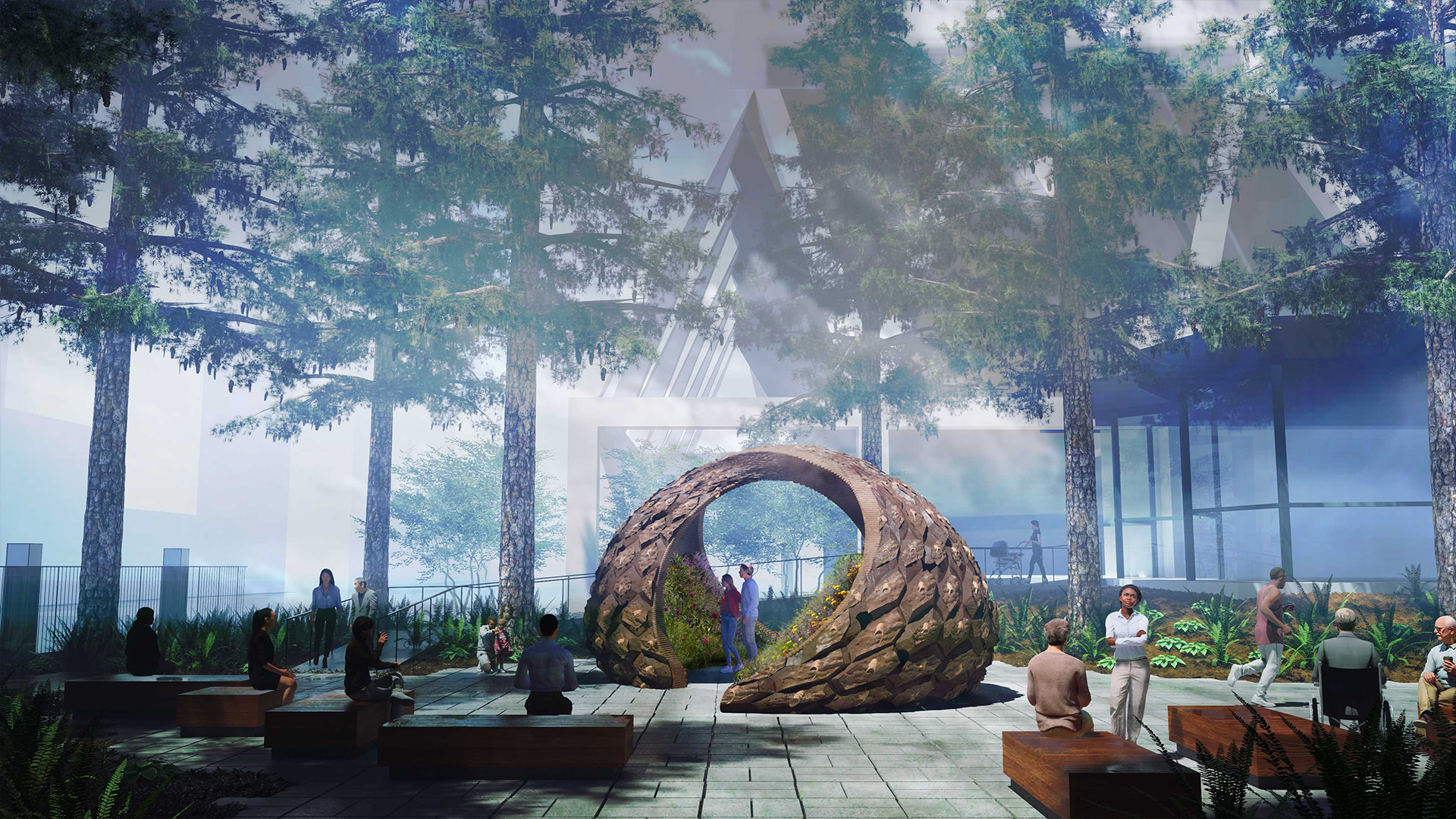
A rendering of artist Lily Kwong’s “Earthseed Dome” to be presented at the Transamerica Pyramid Center’s Redwood Park in January 2026 in partnership with the Institute of Contemporary Art San Francisco. Courtesy of Lily Kwong and Atelio
ICA SF Director and Chief Curator Alison Gass told the Chronicle in an exclusive interview that following the success in the Cube at 345 Montgomery St., the museum will henceforth be presenting exhibitions in new spaces each cycle. The intent behind this, Gass explained, is both to pair artistic projects with architecturally or historically significant sites and to bring attention to lesser known spaces that can inspire more site-specific art.
It’s also because ICA SF must vacate the Cube in accordance to the two-year agreement they settled on last year. But since the museum has consistently branded itself a “start-up,” Gass said this move is in keeping with that disruptor ethos.
“We have this kind of ability to truly be nimble,” Gass said of the museum’s non-collecting paradigm. “A lot of our commitment is to commissioning new projects, allowing artists to try something new. That often is not just paintings on a wall or sculptures on a pedestal, but it’s really deeply site-responsive projects.”
In that respect, Gass noted that some of the future projects ICA SF envisioned wouldn’t be a physical or mechanical fit for the Cube given the limitations of the former bank building.
“We began to imagine, there’s all these incredible spaces around San Francisco that we can come in and activate,” said Gass. “What if we find the right space for the right project?”
ICA SF moved into the Cube in fall 2024 after two years at 901 Minnesota St., which was intended as a permanent home in the Dogpatch neighborhood, a key arts districts of the city. The Dogpatch location was leased for the museum by Deborah and Andy Rappaport, founders of the nearby gallery hub known as the Minnesota Street Project.
The museum was given two years of free rent and utilities at the Cube by Vornado Realty Trust, the majority owner of the 555 California complex where it is located. Now the Wharton School of Business, which has signed a 10 year lease, will be taking over the Cube within the next 18 months. (The Trump Organization owns 30% of the complex, and President Donald Trump is coincidentally an alumnus of Wharton).
Gass said she believed that the ICA SF residency “made the Cube an iconic and known destination in San Francisco.”
“I really like the fact that contemporary art can have potentially that kind of real tangible economic and cultural impact,” Gass continued. “As we move on, that’s something we’re really aware of in conversation with real estate developers. We’re really interested in this idea of partnership and the way that contemporary art can make spaces more visible, more desirable, bring people to them — all of those things.”
City leaders share that view. San Francisco Mayor Daniel Lurie praised the museum as “a beloved destination for creativity, community, and culture,” saying in a statement that its presence in the Cube “has brought new energy to our downtown over the past year and helped to revitalize the heart of San Francisco.
“I’m thrilled that ICA SF’s plans for multiple activations and installations will continue to play a vital role in our downtown recovery.”
As ICA SF pivots to the nomadic concept, a central question will be whether the strategy makes financial sense. Museums require infrastructure such as security, exhibition maintenance and designated administrative space in addition to venues to display art.
But Gass said ICA SF is accounting for those needs. She’s also been looking to organizations that specialize in presenting art in nonpermanent spaces such as Creative Time, the Art Production Fund and the Public Art Fund in New York for inspiration.
Meanwhile, the museum is in the process of seeking a permanent home for its offices. She does not expect the museum to need to increase its annual $2.5 million budget, and said ICA SF will maintain the free admission policy it has had since its inception.
That confidence, Gass added, comes from the museum’s reliable audience. Patrons followed them to the Cube, and she believes they’ll continue to show up wherever ICA SF goes next.
It all begins at the Transamerica Pyramid Center in January with a dual presentation.
Inside the building’s Annex exhibition space, Brooklyn sculptor Tara Donovan’s large-scale “Stratagem” sculptures will be on view, including two works that have not been shown publicly. The works in the “Stratagem” series are made from thousands of recycled CDs, reflecting the shifting of exterior light visible in the glass structure.
Outdoors in Transamerica Redwood Park, landscape artist Lily Kwong, who was born in San Francisco but is now based in Los Angeles, will create a site-responsive installation titled “Earthseed Dome.” A 3D-printed living soil installation with fabrication led by Atelio and WASP 3D, the piece will dramatically transform the park and continue to evolve as new plant life grows through its period on view.

Stratagems (installation photo), 2024, CDs, concrete, stainless steel by artist Tara Donovan. Melissa Goodwin/For Tara Donovan
Both installations will open Jan. 17 during San Francisco Art Week and be on view through July.
In partnership with art week, ICA SF will also host a nine-day public lounge and cultural hub at the Transamerica Pyramid Center. The lounge and two art installations will all be supported with grants from the Svane Family Foundation’s Culture Forward initiative.
Since 2024, the Transamerica Pyramid has hosted exhibitions through its Pyramid Arts nonprofit. Along with neighboring galleries Rebecca Camacho Presents and Gallery Wendi Norris (which is currently presenting sculptures by Max Ernst in the Pyramid’s Redwood Park), it has helped turn the area into a visual arts destination.
Michael Shvo, chairman and CEO of the New York City-based real estate development company SHVO that owns the Transamerica Pyramid, said ICA SF’s nomadic model “only works if they find the right partners … that are equally committed to the arts.” That makes the museum’s collaboration with his site a natural fit.
“Our commitment to arts and to public art is where our alignment with ICA SF is extremely strong,” said Shvo. “Our advantage is because of the presence of the Transamerica Pyramid, the importance of the building, and because the building is the center of downtown today, it allows us to bring to the public shows that they might not have access to. The great thing about public art is that it’s free, it’s open and it’s not intimidating.”
As a bonus, Pyramid Arts already has security and exhibition tech infrastructure in place that ICA SF can utilize.
In late spring, ICA SF plans to present a joint exhibition by New York artists Dominique Fung and Heidi Lau, guest curated by Kathy Huang, at Pier 24.
The show, which Gass compared to “creating an ancient Chinese excavation site,” will feature existing paintings as well as newly commissioned sculptural and immersive works. Among them will be “A Tale of Ancestral Memories,” an 88-foot long painting by Fung that Gass said “takes a full minute to walk by.”
Lau, known for her work as a ceramicist, will be creating a hanging installation reminiscent of oyster beds. The pieces will have a robotic component allowing them to open and close in conjunction with the tide.
“Heidi’s other vision for this was that the light in the space would change slowly in accordance with the tide clock,” said Gass, something she noted would have been impossible to manage in the light conditions in the Cube.
ICA SF is still in negotiations with the Port of San Francisco for use of the pier, formerly home to Pier 24 Photography, which displayed pieces from the collection of the Pilara Foundation from 2010 to January 2025.
In 2027, the museum then plans to create a still-to-be-determined project at Prequel Park, within the Dogpatch Power Station. It will be within a 300-foot former smokestack now known as the Stack, which will be repurposed into a vertical gallery space. Participating artists and the exact nature of the ICA SF’s exhibition are still being determined.
Heatherwick Studio, known for creating Little Island in New York City, will design the Prequel Park project, which is being developed by the real estate firm Fifth Space.
“What’s great about the ICA SF is our comfort with not always knowing exactly what the longer-term future holds,” Gass said. “But I, our board and our team fully understood that this was an opportunity to continue to experiment.”